Converts
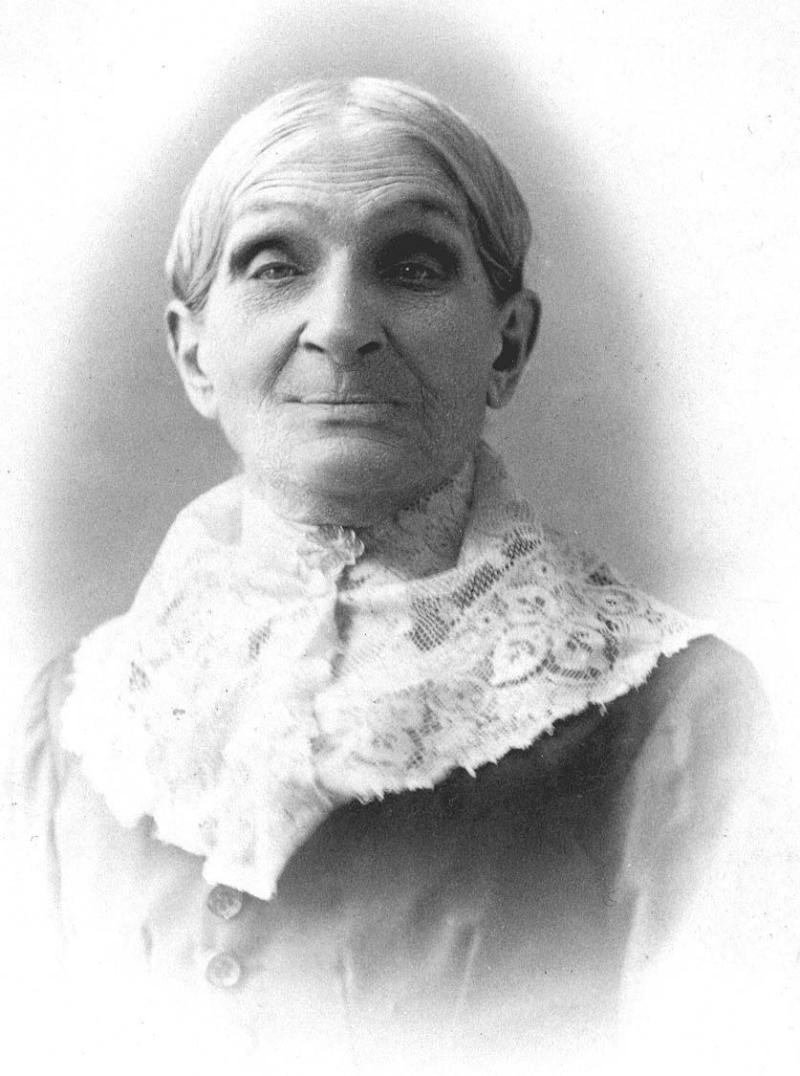
Mary Ann Hoopes
Birth
Tuesday, Jan 8, 1811
East Goshen, Pennsylvania
Baptism
Thursday, Jul 22, 1841
Nauvoo, Illinois
Baptized by: Joseph Smith, Jr.
Death
Sunday, Nov 22, 1903
Salt Lake City, Utah
Burial: Salt Lake City, Utah



Married David Dutton Yearsley, 11 Sep 1830, Westchester, Chester, Pennsylvania Children - Mary Jane Yearsley, George Hoopes Yearsley, Elizabeth Yearsley, David Dutton Yearsley, Lavenia Elizabeth Hoopes Yearsley, Heber Chase Yearsley, Nathan Yearsley, Emma Smith Yearsley Married Albern Rufus Allen, 29 Feb 1852 Mary Ann Hoopes Yearsley was the second child in the family of George Hoopes and Aleina Woodward, and she was born January 8, 1811, in Chester County, Pennsylvania.
The family belonged to the Society of Friends or “Quakers” and were true to their convictions. They believed in and practiced the principles of honesty, industry, and frugality; were ready to give comfort to the needy and those in distress; seeking neither notoriety nor publicity, but appreciating the society of honorable people and those who stood for righteous principles. And as an illustration of these virtues, we note that on the occasion of the visit of Marquis Lafayette to America many years after the war, that is the Revolutionary War, in which he and his noble French troops played so important a part, it so happened that while he was passing through Pennsylvania, he stopped for dinner at a hotel where Mary Ann Hoopes was visiting, and as there were so many guests to be cared for she was asked to assist in waiting on them, which she cheerfully consented to do, and was assigned to wait upon the table of Lafayette. Though she was only fifteen (15) years of age, the occasion was so impressed upon her memory that she frequently referred to it as one of the pleasing and important occasions of her life.
Not long after the foregoing event, Mary Ann met with and married a young man of the Society of Friends, David Dutton Yearsley, and who was about five years her senior, and who had received from his father’s estate a comfortable fortune and a prosperous business which he carefully guarded and conducted.
Biography - David Dutton Yearsley [Mary’s first husband], Giving His All, submitted by LaRon Taylor. David Dutton Yearsley was raised in a prosperous religious family in Pennsylvania and belonged to the Society of Friends “Quakers”. His father was a successful merchant and, after his death, David inherited the family business and a considerable amount of wealth. He was a wise steward with his father’s fortune, but events later in life took that from him. He met Mary Ann Hoopes who was also a member of his faith and they were married on 11 Sep 1830. Shortly after their marriage, they took George W. Boyd, a 9-year-old orphan boy, into their home and raised him as one of their own children. About 10 years later, David & Mary Ann heard the missionaries of The Church of Jesus Christ of Latter-day Saints and were so impressed with their message that they traveled to Nauvoo to learn more. They met Joseph Smith, learned more about the church, and were convinced that he was truly a prophet. They returned home, sold their belongings and moved their family to Nauvoo where they built a 3-story brick home which is still standing. It was the only 3-story home in Nauvoo. They also soon opened a mercantile store which was very successful. David bought $3,000 worth of stock in the Nauvoo House on Feb 6, 1841 which was 5 months before their baptism. David and Mary Ann were baptized on Jul 22, 1841 by the Prophet Joseph Smith. It was interesting to note that after the baptism, Joseph Smith took a swim out into the Mississippi and back. The new members, especially Mary Ann, were greatly surprised that a prophet would do such a deed right after performing the baptisms. Though the Yearsley’s were wealthy, they were humble and charitable. They received many requests for financial help from the prophet and from other members. Those requests were promptly honored and some were never repaid, but the Yearsley’s never complained, nor did they tell their children of those problems. On one occasion, D. D. Yearsley was surprised by a company of the Nauvoo Legion that Joseph had sent to him with a request that he outfit all of them with a pair of boots with the promise that he would be repaid. He managed to do so but some of the men had to settle for shoes that were not the right size. David Dutton Yearsley was a good friend of Joseph Smith and was frequently consulted with concerning various matters. Joseph Smith appointed David as one of a committee of 5 men to go west into the Oregon Territory to scout out some land where the Saints could live and worship without persecution. This never happened, however, because the prophet was martyred shortly after that and the men never made the trip. One record shows that David Dutton Yearsley entered into the new law of plural marriage in 1846 before being driven from Nauvoo, but the author has been unable at this point to find records of this family. The wife’s name was Harriett Wollerton Dillworth Caulflesh. The name would indicate that she was probably a widow but records of her previous family history are yet to be located, so no further mention of this person will be contained in this history. The Saints were driven from Nauvoo in 1846 and our Yearsley family was in that group. They left their large fully furnished home and packed the needed items for the trip. Then they helped outfit several other families for the trip. When they left, there was a family too poor to move so David & Mary Ann told them to stay in the home and sell what they could so they could outfit themselves and catch up with the saints. Records show that Yearsley’s were on the West side of the Mississippi on 14 Feb, 1846 and were struggling with fresh snow and cold. On the 19th, another snow storm hit and the cold was bitter. David Dutton was appointed as Commissary for Heber C. Kimball’s camp of 50. On 29 March, the company had only made it about 100 miles from Nauvoo because of the extreme cold, snow, and wind. D. D. Yearsley and company went out looking for work in the country on 15 April, while other companies continued on. All days weren’t so bad though because the same record indicated that Mary Ann enjoyed a pleasant outdoor quilting party with other sisters of the company on 17 May, and all had a great time. The Yearsley’s made their way through the bitter cold winter weather to Winter Quarters. The hardships were so extreme that some entire families were buried along the way. “Thus, from day to day, slowly and wearily traveling, went the exiled Saints across the undulating surface of snow-covered Iowa. The Roads were very bad, the weather cold and stormy, and the streams, now frozen, now swollen by spring freshets, almost and at times quite impassable. Again and again they were obliged to double teams on the heavily loaded wagons, to drag them through deep streams and miry marshes on their line of travel. Some days three or four miles would be the extent of their journey. Many a halt was made, at times for weeks.” After arriving at Winter Quarters, the Mormon Battalion was formed and both George W. Boyd and Benjamin Roberts, another boy the Yearsley’s had allowed to stay with their family, volunteered to go with the Battalion. They were both allowed to go in spite of the fact that many of their cattle had died on the journey to Winter Quarters, and D. D. Yearsley would have to return to Missouri to trade any of his remaining supplies which had been left behind for more animals and food. Before the Yearsley’s left Winter Quarters, Benjamin Roberts was released from the Battalion and he returned to the Yearsley family to help them across the plains. Records indicate that they traveled with the Heber C. Kimball company in 1848. They stayed a time in Rocky Ford on the Platt River and David Dutton Yearsley died there from pneumonia which came as a result of the hardships and exposure he had been subjected to. As it turned out, the return of Benjamin Roberts was a God-send because he did his best to help the family at that point. There wasn’t even any wood available for a coffin, so Benjamin cut planks from a tree by hand and made a coffin and buried David there. Another blessing to the family in their distress was an inheritance Mary Ann received from her father’s estate that made it possible for her family to properly outfit themselves for the rest of the journey west. In fact, she shared that inheritance with others that were also destitute in the group, thus making it possible for several families to make the trip. Benjamin continued helping Mary Ann and her eight children until they arrived in Salt Lake City, Utah. They joined the company of Captain Thomas Johnson and continued west and arrived in Salt Lake City, Utah in on 18 September 1850. In 1851, Mary Ann moved with her children to Weber (now Ogden) and located along the Weber River. Her boys took the boxes off of the wagons and hauled timber from the mountains to build their first home there. In the mean time, the family planted the wagon boxes in the side of the hill for shelter. The home was built and they lived there for one year before moving to North Willow Creek (now Willard). They again built a log cabin and began tilling the earth. In this new location, she met Albern Allen and became his second wife. Because of this marriage, Albern’s son Rufus met Mary Ann’s daughter Lavenia and they were married shortly after that. That would mean Rufus married his step-sister. As Mary Ann aged, she retained all of her faculties but became hard of hearing. She died while at the home of her granddaughter because her clothing caught on fire while the family was away. She was ninety three years old. That isn’t remarkable in today’s world, but in her world that was phenomenal! The legacy of David Dutton Yearsley and Mary Ann Hoopes is a trail of hope, faith, and charity. This fine couple shared what they had when they had much and when they had little. Though they endured hardships that one can’t imagine, their faith never wavered and they were admired by many then and now.2
The David Dutton Yearsley family descended from John Yearsley, who, with his wife, Elizabeth and five children migrated from England to Pennsylvania in the year 1700. He was a Quaker and a member of the Parrish in Middlewich, Cheshire, England which town was probably his birthplace in approximately 1650. Pursuant to the custom of the Quaker religious society to which he belonged, he brought with him the following certificate: “This is to certify to whome it may concern the ye bearer, John Yearsley of Middlewich, hath had a desire and inclination to transport himself, wife and children unto ye province of Pennsylvania; and he having laid before ye meeting of ye friends at Middlewich, whereof he is a member, his desire and intention fro so doing, and desire ye consent and advice of ye meeting for so great weighty an undertaking. And finding no friend or friends yt do gainsay ye contrary, now knowing nothing but yt he hath walked humble with the Lord, and according to truth, and done equally and just with all persons with whome hath had to deal with all: and yt his wife and children have walked carefully and without blame as with relation to ye truth, wee have nothing to charge them with, but desiring their prosperity and welfare in ye same, doe give them this our certificate to our well beloved friends in Pennsylvania, desiring their reception of them in Love and Unity, if God All-Mighty bee please to bring them safe thither, as we shall doe for any yet may have a desire to return from thense with your certificate. Signed at our monthly meeting, held at Nampwich ye 29th of ye 6th month 1700.” David Dutton Yearsley who is the son of Nathan; the son of Jacob; the son of Jacob; the son of John; son of John, the first to immigrate to the colonies in America, was born on March 3rd 1808 in Thornbury, Chester County, Pennsylvania. David was raised in a prosperous religious family in Pennsylvania and belonged to the Society of Friends “Quakers”. He was raised in a strict but loving home with two sisters and one brother. His father was a successful merchant and, after his death, David inherited the family business and a considerable amount of wealth. He was a wise steward with his father’s fortune. Mary Ann Hoopes was the second child of eight children, the daughter of George Hoopes and Abinah Woodward. She was born on the 8th of January, 1811 in East Goshen, Lancaster, Pennsylvania. The children we: George Washington, Mary
Ann, Robert Fitzgerald, Lavinia Miller, Elizabeth Garrett, Abiggail S, Esther Painter, and Caroline T (Caddie) Hoopes. Mary Ann and her family were also members of the Society of Friends and it was through this group that she met her future husband, David Dutton Yearsley. David and Mary Ann were both taught the value of honesty, industry, frugality, and were always, throughout their lives, ready to give comfort to the needy and those in distress, seeking neither notoriety nor publicity but were very much appreciative of the society of honorable people and those who stood for righteous principles. In 1824 General Marquis La Fayette was invited by President James Monroe and Congress to visit the United States. La Fayette was a French aristocrat who joined the Revolutionary War at this own request and became one of the most successful leaders in combat and General George Washington’s most loyal companion. It so happened that he and his party stopped for dinner at a hotel where Mary Ann was visiting and as there were many guests to be cared for, Mary Ann was asked to assist in waiting on the guests which she cheerfully consented to do. She was assigned to wait upon the table of the Marquis. Though she was only in her early teens, the occasion was so impressed upon her memory that she frequently referred to it as one of the pleasing and important occasions of her life. Not long after the foregoing event, Mary Ann met young David Dutton Yearsley. The two were married on the 11th of September 1830. David had been trained in the mercantile business and also the hotel business and as a result was able to provide well for Mary Ann and make a good home for them. At the time of the marriage David was manager of an inn in Pennsylvania. He was twenty-one and Mary Ann was eighteen years of age. During their first year of marriage they would adopt and received into their home a nine year-old orphan boy by the name of George W. Boyd. They raised this boy as one of their own children. This boy would remain with the family as they moved to Nauvoo and then on to the Salt Lake Valley. About ten years after their marriage they were visited by some missionaries of The Church of Jesus Christ of Latter-day Saints. Elder Lorenzo Barnes and some others were preaching in the Chester County area. They taught the message of salvation, the restoration of Christ’s Church on earth and the Book of Mormon which so impressed this fine couple that Mary Ann wanted to be baptized immediately. Her husband was rather reluctant to accept this new religion sorapidly, however, David said to his wife: “Mary Ann, knowing you as I do, and respecting your keen intelligence, I am certain there must be something in your attention and belief.” A few months later David proposed to his wife that they make a trip to Nauvoo to make an on-the-spot investigation of the new religion and it founder. They traveled by steamboat down the Ohio River and then up the Mississippi River to Nauvoo. There they met and conversed with Joseph Smith the Prophet and heard his personal testimony as having seen two Heavenly Beings and of the subsequent work of translating the Book of Mormon and the work associated with it. David was truly convinced that Joseph was sincere and a prophet of God. During the visit the Prophet shared with the Yearsleys that the Lord had revealed to him that he was to form a stock company and build a house that would become known as the Nauvoo House. The stock was valued at $1.00 per share. Mr. Yearsley quickly took stock to the extent of $3,000 which he paid for at once. The certificates bear the date of February 6, 1841, which was more than six months prior to their baptisms. On July 22nd 1841, David Dutton and Mary Ann Hoopes Yearsley were baptized by the Prophet Joseph Smith in the Mississippi River. After the ordinance was performed the Prophet swam out into the river a short distance, which greatly surprised the new members. Mary Ann thought it was a very strange thing for a prophet to do. It certainly did not affect their faith in the divinity of his mission nor the genuineness of his claims. They returned home, sold their home, the inn and the mercantile business and moved to Nauvoo in the spring of 1842. The family consisted of seven children: Elizabeth, born 1831; Lavinia, born 1833; Nathan, born 1835; David D., Jr., born 1837; Mary Jane, born 1838; George, born 1840; along with the adopted son, George Boyd. A daughter, Emma Smith would be born shortly after their arrival in Nauvoo. Upon arriving in Nauvoo they found temporary shelter while David negotiated with Joseph Smith for the property of Lot 4, Block 95, on the northwest corner of White and Partridge Streets. David paid the Prophet $1,000 in gold. Construction began immediately on a three story red-brick home. Four masons were employed to lay the sturdy stone foundation and the brickwork. George Woodward was the foreman of the group and John M. Horner was one of the masons. Jacob Weiler and Elijah Malin, also converts from Chester County, Pennsylvania were the contractors and carpenters. The home was built for $2,000 and is three stories tall with a full basement. A massive stone pier in the full basement supported the brick fireplaces and hearths in both the north and south rooms on both the first and second floors. The interior woodwork was the Greek revival style. There is a large kitchen and an equally large parlor on the main floor. The bedrooms were on the second and third floors. The temperature in the basement remained even year-round so that there was never a problem storing food. Mary Ann furnished the home with all the comforts that money and a husband in the mercantile business could provide. The family took occupancy of the home in 1843. About this time a young man, Benjamin Morgan Roberts, born in 1826, also from Chester County, Pennsylvania, was taken in as a member of the Yearsley household. Shortly after arriving in Nauvoo David opened a dry goods, shoes, and provision store on Mulholland Street just east of the Temple. He named the store after his home state, the Keystone Store. Records also indicate that he also ran a second store. These were all successful allowing him to make a good living for his family. The operation of two stores along with money from his father’s estate, allowed the Yearsley family to live most comfortably while assisting others in need, especially the Prophet Joseph and his family. In January of 1843 Joseph Smith organized “The Young Gentlemen’s and Ladies’ Relief Society” – the forerunner of the Mutual Improvement Associations. Some of the meetings of this group were held in the large front room of the Yearsley home – a sort of Sunday evening fireside, where prominent Church leaders addressed the group. On weekdays the young people would hurry home from school complete their chores and then rush over to the Yearsley home where seated on boxes they would study the Bible and Book of Mormon. David, well read, would be the teacher. Though the Yearsley’s were wealthy, they were humble and charitable. The received many requests for financial help from the Prophet and others members. Those requests were promptly honored. On one occasion David and Mary Ann were surprised by a company of the Nauvoo Legion that Joseph had sent to him with a request that he outfit all of them with a pair of boots or shoes as many of them were nearly barefoot. David was given a promise that he would be repaid.
He managed to outfit the Legion but some of the men had to settle for shoes that were not the right size. For David and Mary Ann it was a show of confidence in and compliance with or obedience to a request made by one whom they looked upon as God’s mouth-piece on earth. It was their great pleasure to try to meet any and all requirements made from that source – Joseph Smith the Prophet. Mary Ann was one of the early members of the Relief Society. She firmly believed there was a need for such an organization among the women. She often related that she was at the very first meeting. She was an active participant throughout her life. Mary Ann was also blessed with the “Gift of Tongues” and for a time Emily Richardson was her interpreter. David, Mary Ann, Joseph and Emma were always on very intimate terms and enjoyed each other’s company. One once occasion the Prophet went to the Yearsley store to buy a dress length, a beautiful imported brocade, for Emma. He asked David to measure another just like it and to wrap it separately. As he left, Joseph handed David the second package and asked him to give it to Mary Ann so that she and Emma could wear their dresses in church together. Mary Ann never forgot the gesture and kindness shown to her. David was a member of the High Council in Nauvoo, a member of the Council of Fifty, a bishop, a commissary and a county commissioner, and one of four men selected by the Prophet Joseph to explore the Oregon Territory. During one High Council Meeting Hyrum Smith read the revelation of Plural Marriage, Sec. 132 of the Doctrine & Covenants. David would enter into that order of the priesthood while in Nauvoo. His second wife would be Harriett Wollerton Dillworth Caulflesh. David was looked upon as one of the most faithful members of the Church and was frequently visited by the Prophet and was called into council with him on important occasions. The Journal of History records the following: “Joseph Smith said: ‘If we attempt to accomplish this, you must send every man in the city who is able to speak in public, throughout the land to electioneer and make stump speeches, advocate the Mormon religion, purity of election, and call upon people to stand by the law, and put down mobocracy. David Yearsley must go; Parley P. Pratt to New York;
Erastus Snow to Vermont, and Sidney Rigdon to Pennsylvania.’ JH, 1844, Jan-Dec
“Joseph rode out in the evening to see David Yearsley’s child who was sick, and returned home at 9 p.m. JH 1844, Jan-Dec
“The twelve arranged for appointments for general conferences. The names of Elders were also decided who were appointed to several states. Pennsylvania, David D. Yearsley 1st, Edson Whipple 2nd. Those numbered will take the Presidency. JH 1844
“Council of Twelve meeting in Joseph’s office. Meeting was for the purpose of selecting a company to explore Oregon and California and to select a site for a new city for the saints. Jonathan Dunham, David D. Yearsley, Phinehas H. Young and David Fuller volunteered to go. Others were requested to go.” JH 1844 On the Monday morning of June 24th at 6:30 a.m. Joseph, Hyrum, the other sixteen men under indictment, James W. Woods their attorney and as many as a dozen others began their trip to Carthage. Twice Joseph returned to the Mansion House to bid farewell to his family. From the Smith home, the company road up Main Street on horse-back and in wagons. They waved goodbye to all those along the way. As the Prophet Joseph and his party were passing by the Yearsley home he waved his hand to Mary Ann who was standing in her doorway. The party paused at the unfinished temple. From the edge of the bluff, Joseph looked admiringly at Nauvoo. He pondered what he had attempted to accomplish for his followers in this city of refuge. “This is the loveliest place and the best people under the heavens,” he said. “Little do they know the trials that await them.” Once more the group headed toward Carthage. At his farm, the Prophet turned his head for several last looks at the prosperous layout. To those who commented on his several looks back he said: “If some of you had got such a farm and knew you would not see it any more, you would want to take a good look at it for the last time.” On the 27th of June, Joseph and Hyrum would be murdered in cold blood! It was 8:05 p.m. When tragedy struck the City of Nauvoo on June 27, 1844 with the deaths of Joseph and Hyrum in Carthage Jail, David Yearsley and Edson Whipple were serving a mission in Pennsylvania advocating the nomination of Joseph Smith for the Presidency of the United State. David did not return from this mission, according to records, until November 1844, having used the time following the prophet’s martyrdom to reassure the saints and gain converts.
When Mary Ann received word of the murder of Joseph she took her children and hid in the darkest part of the house because she was so afraid of what might happen. With David gone on his mission, she felt they had little protection if trouble came. As soon as Mary Ann felt safe she immediately rushed to Emma Smith’s home with offers of help and sympathy. On Saturday from eight in the morning until five in the evening a procession of thousands passed in at the west front door of the Mansion House to view the martyred Prophet and Patriarch. “Every heart is filled with sorrow, and the very streets of Nauvoo seem to mourn” said Vilate Kimball. Upon David’s return he was asked by Emma Smith to take responsibility of managing the Red Brick Store. He graciously accepted the invitation without hesitation. Once again serving Joseph and Emma whom he loved so very much. David was selected one of five committeemen to be the legal voices of Nauvoo citizens after the martyrdom. The Journal History record this entry dated September 16, 1845: “The authorities of the Church issued the following proclamation to Col. Levi Williams and the mob party, of whom he is the supposed leader, who have been and are still engaged in burning the houses and property of the peaceable citizens of Hancock county: We the undersigned, a committee of the citizens of the city of Nauvoo, have selected a committee of five: Peter Haws, Andrew H. Perkins, Erastus H. Derby, David D. Yearsley and Solomon Hancock, who will be the bearers of this to you, to confer with and inform you that it is our intention to leave Nauvoo and the county next spring, provided that yourselves and all others will ceases all hostile operations so as to give us the short but necessary time for our journey, and we want you to return as answer in writing by our said committee, whether you will cease your destructive operations, and vexatious law-suits, and give us the opportunity of carrying out our designs peaceably.” A change in Church leadership was imminent and there were various factions competing for position. Warren Foote recorded in his journal: “We all felt as though the powers of darkness had overcome, and that the Lord had forsaken His People. Our Prophet and Patriarch were gone! Who now is to lead the Saints? In fact we mourned ‘as one mourneth for his only son.’ Yet after all the anguish of our hearts and deep mourning of our souls a spirit seemed to whisper ‘All is well . . .’ So we felt trust in God.”
On Tuesday August 6th a meeting was called for all the Saints to gather to hear Sidney Rigdon and Brigham Young talk about leadership in the Church. Brigham Young had spoken on the authority of the Quorum of Twelve Apostles as outlined in the Doctrine & Covenants and in the words of the Prophet Joseph. A vote was taken and the Saints agreed to follow the Twelve. Many of those in attendance received a personal witness that Brigham Young had appropriately replaced Joseph Smith. For them, including Mary Ann and her family, the very appearance, actions, and voice of Brigham Young were those of the dead Prophet Joseph. “The Mantle of Joseph fell upon Brigham Young and they knew that he had been chosen by the Lord. Nothing changed regarding the constant persecution and so it became evident that the saints were going to have to leave Nauvoo. David felt the need to sell his home as quickly as possible and try to dispose of his store. He sold his home for $1500. His store was purchased by Mr. A. A. Lathrop. Work on the Nauvoo Temple had continued on and by November of 1845 much of it had been dedicated and was being used to extend the higher priesthood ordinances such as endowment and sealing for time and all eternity to the saints prior to leaving for the trek west. On the 18th of December 1845 both David and Mary Ann would receive their endowment and on the 21st of December they would be sealed together for time and all eternity. The Yearsley family was forced from the City Beautiful with the other Saints and crossed the icy Mississippi River in February 1846. David secured several wagons and loaded them with dry goods, shoes, and provisions that could be used in the new location. A herd of cattle was also moved across the river. They left their home well furnished, taking with them only the necessary items they could easily transport. As Mary Ann was not used to riding in a springless wagon David provided her with a very nice carriage to ride in. David and Mary Ann helped outfit several other families for the trip. When they left, there was a family too poor to move so David and Mary Ann told them to stay in the home and sell what they could so they could outfit themselves and catch up with the saints. The store was sacrificed in a similar manner. Records show that the Yearsley’s were on the West side of the Mississippi on 14 February 1846 and were struggling with fresh snow and cold. On the 19th another snow storm hit and the cold was bitter. David was appointed Commissary for Heber C. Kimball’s camp of 50. On the 29th of March the company had made only about 100 miles from Nauvoo because of the extreme cold, snow and wind. Many of the men including David went out looking for work in the country while others companies continued on. All days were not so bad because records indicate that on the 17th of May Mary Ann enjoyed a pleasant outdoor quilting party with other sisters of the company and all had a great time. The family reached Council Bluffs, Iowa in June of 1846 and it was here that a call came for 500 young men to serve in the war with Mexico. George W. Boyd and Benjamin Roberts were among the very first to respond to the call from Brigham Young to become part of the Mormon Battalion which would make a 2,000 mile march to the Mexico border near San Diego, California. With 500 enlistees there were many of the men without adequate shoes to undertake the march to Fort Leavenworth and then on to Mexico. David once more opened his heart and his shoe boxes and invited the men to help themselves. Mary Ann reported that not one pair of men’s shoes were left when they marched off to the Mexicana War. The Yearsley’s made their way through the bitter cold winter weather to Winter Quarters, Nebraska. The hardships were so extreme that some entire families were buried along the way. “Thus from day to day, slowly and wearily traveling, went the exiled saints across the undulating surface of snow-covered Iowa. The roads were very bad, the weather cold and stormy, and the streams, once frozen, now swollen by spring runoff were at times impassable. Again and again they were made to double teams on the heavily loaded wagons, to drag them through deep streams and miry marshes on their line of travel. Some days just three or four miles would be the extent of their journey. Sometimes they would stopped for weeks.” Upon arriving in Winter Quarters a quick settlement was established as David would return to Nauvoo to purchase needed supplies and replacement cattle for the ones that had died during the severe winter. Winter Quarters would be home for the next two years. David established a mercantile store which would have supplies for other wagon trains and handcart companies coming in the future. With large numbers of Saints gathering at Winter Quarters before pushing on to the Salt Lake Valley President Brigham Young divided the people into thirteen ecclesiastical wards with a bishopric over each ward. David Yearsley was ordained and set apart as the Bishop of the 12th Ward. In September of 1848 Mary Ann would deliver her last child a son named Heber Chase. During this same year the family moved across the Platte River to the Iowa side of the river to Rocky Ford. While living here David was elected as County Commissioner of Pottawattamie County. Benjamin Roberts also returned from serving with the Mormon Battalion. In the spring of 1849, while planning to move his family to Utah, David contracted pneumonia and died. The disease came as a result of the hardships and exposure he had been subjected to. As it turned out the return of Benjamin Roberts was a tender mercy from God himself as he did all he could to help the family at that time and with their eventual move to Utah. There was no wood available for a coffin. Benjamin cut planks from a cottonwood tree he fell by hand and made a coffin. Mary Ann had a bolt of white satin that she was taking with her so she used it to line the coffin. A beloved wife and eight children along with Benjamin Roberts laid Bishop David Dutton Yearsley to rest at Winter Quarters, Nebraska at the age of 41. The death of her husband delayed the departure of Mary Ann and the family, but in 1850 she took her family, now numbering eight children, one grandchild and Benjamin Roberts to Utah. Just prior to leaving Rocky Ford Mary Ann would receive another blessing. An inheritance from her father’s estate would arrive. The amount of money made it possible for her family to properly outfit themselves for the rest of the journey. In fact, she shared that inheritance with others that were also destitute in the group, thus making it possible for several families to make the trip. Benjamin continued to help Mary Ann and the family until they arrived in Salt Lake City, Utah on the 18th of September 1850. In 1851 Mary Ann moved with her children to Weber (now Ogden) and located along the Weber River. Her boys took the boxes off of the wagons and hauled timber from the mountain to build their first home there. In the meantime the boys planted the wagon boxes in the side of the hill for shelter. The home was finished and the family lived there for a year before moving to North Willow Creek (now Willard near Brigham City). Willard became home and a log cabin was constructed and the surrounding earth began to be tilled. In this new location Mary Ann met Albert Allen, who had served in the Mormon Battalion and married him. Mary Ann and Albert had one child a daughter names Marcie Ann Allen. In the later years of her life Mary Ann returned to Ogden. As she aged she retained all of her faculties but became hard of hearing. She died while at thehome of her granddaughter because her clothing caught on fire while the family was away. On the 22nd of November 1903, at age 93, Mary Ann Hoopes Yearsley, after fifty-four years of living without her husband, slipped through the veil into the loving arms of her beloved David. What joy and rejoicing must have taken place as covenants were kept and promises were brought to fruition as David Dutton and Mary Ann Hoopes Yearsley were once more united for all eternity. The legacy of David Dutton Yearsley and Mary Ann Hoopes is a trail of hope, faith, and charity. It is a living story of living the “Law of Consecration” as they shared what they had when they had much and still shared what they had when it was little. Their love of God and Jesus Christ, love of Joseph and Emma, Brigham, Heber and others, love of their children, love of an orphan boy, their testimonies, courage, loyalty, devotion, determination, strength, and never wavering in their faith are examples never to be forgotten. At the end of their mortal lives they had caught the vision of becoming like God – full of care and concern for others which flowed from each of them naturally.
3
In compiling the following brief sketch of the life and labors of one of Utah’s most patriotic and esteemable daughters, no effort is made to present them in a sensational manner, but to give to the reader some plain, unvarnished facts which I trust shell be interesting in the light of patient devotion to duty and the welfare of mankind.
J. D. Cummings, Salt Lake City, Utah April 16, 1914
Mary Ann Yearsley was the second child in the family of George Hoopes and Albina Woodward, and was born January 8, 1811, in Chester County, Pennsylvania.
The family belonged to the Society of Friends or “Quakers”, and were true to their convictions. They believed in and practiced the principles of honesty, industry, and frugality; were ever ready to give comfort to the needy and those in distress; seeking neither notoriety nor publicity, but appreciating the society of honest people and those who stood for righteous principles, and as an illustration of these virtues, we note that on the occasion of the visit of Marquis La Fayette to America many years after the close of the Revolutionary War, in which he and his noble French troops played so important a part, it so happened that while he was passing through Pennsylvania, he stopped for dinner at a hotel where Mary Ann Hoopes was visiting, and as there were so many guests to be cared for, she was asked to assist on waiting on them which she cheerfully consented to do, and was assigned to wait upon the table of La Fayette. Though she was only fifteen years of age the occasion was so impressed upon her memory that she frequently referred to it as one of the pleasing and important occasions of her life.
Not long after the foregoing event, Mary Ann met a young man of the Society of Friends, David Dutton Yearsley, who was about five years her senior, and who had received from his father’s estate a comfortable fortune and a prosperous business which he carefully guarded and conducted. The friendship grew into love and they were married in 1830.
Soon after their marriage they received into their home an orphan boy, nine years of age, by the name of George W. Boyd, whom they reared as carefully as they did their own children later in life.
Probably about ten years later, they were visited by some Latter Day Saint missionaries who were traveling in that part of the state, and delivered to them a message of salvation which impressed them very much; in fact they were so interested in what they heard that they decided to go to Nauvoo, Illinois, the headquarters of the new church and investigate for themselves. They made the journey, and met and conversed with Joseph Smith, the Prophet, upon his claims to having seen heavenly being(s) and their instructions to him. So thoroughly were they convinced of the genuineness of his claims, that they soon decided to sell out their property in Pennsylvania and cast their lot with the new church, which they did in a short time and moved to Nauvoo.
Soon after arriving at their new home they were told by the Prophet that the Lord had revealed to him that he desired to form a stock company and build a house to be known as the Nauvoo House. The stock company was to be valued at $1.00 per share, and as soon as the company was incorporated, Mr. Yearsley quickly took stock to the extent of about $3,000.00, which he paid for at once. The certificates bear the date of February 6, 1841, which was more than five months before this couple were baptized into the Church, which took place July 22, 1841, when they were led by Prophet Joseph Smith into the Mississippi river and baptized. After the ordinance was performed, the prophet swam out into the river a short distance, which greatly surprised new the members as they (especially Mrs. Yearsley) thought it a very strange thing for a prophet to do, but it did not affect their faith in the divinity of his mission, nor the genuineness of his claims.
Mrs. Yearsley was one of the women present at the Organization of the first Relief Society, organized by Joseph Smith.
So much did the Prophet appreciate the devotion and faithfulness of Mr. Yearsley that he selected him as one of a committee of five to go out into what was then known as the “Oregon Territory”, to find a place where the Saints could worship according to the dictates of their own consciences, but they did not make the journey for the reason that the Prophet was slain before it could be accomplished.
As soon as he could do so, Mr. Yearsley again engaged in merchandising, renting a brick store from the Prophet for the same. He was again successful, not withstanding the many demands made upon him for charity, as well as to provide money for the Prophet with which to meet the many demands that were made upon him because of the trials and other expensive experiences he underwent. Never was the cry for help made in his presence when it was not promptly met with adequate relief, and on many occasions he provided the Prophet with money and with no other security than the promise that it would be paid as soon as possible, which was generally done, though the late Daniel H. Wells told one of Mr. Yearsley’s daughters in Salt Lake City that he knew of $2000.00 which Joseph borrowed from her father and never paid it back, for the reason that he was slain before it could be done; but neither Mr. Yearsley, nor his faithful wife, ever complained of the loss, nor did they even make the same known to their family, but rather looked upon it as an opportunity to do their duty and show their appreciation of the blessings of the Lord to them.
On another occasion Mr. Yearsley was given an opportunity to show his confidence in the promise of the Prophet of the Lord, when Joseph sent a company of the Nauvoo Legion, a portion of the Militia of the state, to Mr. Yearsley with the request that he furnish them each with a pair of boots or shoes, as they were nearly barefooted, and that the bill would be paid in some way. The demand was so great that it took nearly every pair of boots and shoes to meet it, and even then some were obligated to take shoes or boots too large for their feet, because there were not enough of the proper sizes to meet the demand; still, the principle involved was not the kind, size, nor quality; it was a compliance with a request made by one whom Mr. Yearsley looked upon as God’s mouthpiece on earth, and it was his great pleasure to try to meet any and all requirements made from that source.
Mr. Yearsley was looked upon as one of the most faithful members of the church and was frequently visited by the Prophet or was called into council with him upon important occasions, and the two families were always on very intimate terms.
While in Nauvoo a young man by the name of Benjamin Roberts became a member of the Yearsley family, and remained with them until he went, at the request of the government of the United States, as a member of the Mormon Battalion, when this nation was at war with Mexico.
In 1846, at the time the Saints were driven from their homes in Nauvoo by a cruel mob who told them they would all be killed if they remained, our faithful family joined their equally unfortunate co-religionists and moved from the State of Illinois, crossing the Mississippi River on ice.
Mr. Yearsley provided his family with several teams and wagons and took with him such things as he thought would be most needed under the trying conditions they were to be placed in. He then left his home, and three story brick building, which was thoroughly furnished from cellar to garret, in the care of a family too poor to fit out a team or other necessary articles for the trip, and told them that they were at liberty to use the property and if they could sell any of the furnishing or other articles and fit themselves out and follow the body of the church, to do so. Their store was also sacrificed in a similar manner; but they felt that their going with the Church was of greater importance than remaining to look after property matters, so they sacrificed all for the gospel’s sake, and were one with their brethren and sisters in the sufferings that followed upon their trail.
They went to Winter Quarters (now Florence, Nebraska) where the Mormon Battalion was formed, and Benjamin Roberts and George W. Boyd were taken from them for that service. However, they met the situation bravely, notwithstanding that many of their cattle died and Mr. Yearsley had to go back to Missouri and trade for others as well as for other supplies which he received in exchange for such things as he could spare from his already badly exhausted supplies brought from Nauvoo.
From there they went to other places for short intervals until finally they settled on the place called Rocky Ford. But before leaving Winter Quarters Benjamin Roberts returned to them from his long trip across the Western part of the continent, having been mustered out of the service in California.
While at Rocky Ford Mr.Yearsley was taken sick from exposure and hardships, and died, leaving a widow and eight children to mourn the loss, but they found in Benjamin Roberts a faithful friend, who at once took hold of the situation and did all he could to be a father to the bereft family. As they were far from markets where even the necessaries could be had, they found themselves without even lumber with which to make a coffin for Mr. Yearsley, so Mr. Roberts at once set to work and sawed by hand from the trees nearby, the necessary lumber and then made it into a coffin in which his faithful friend was buried.
Mr. Roberts remained with the family until they were settled in Utah. They took up their line of march with the company under the leadership of Captain Thomas Johnson, who showed them great kindness. However, before they left Rocky Ford, Mrs. Yearsley received her portion of her father’s estate in Pennsylvania and with it provided herself and assisted many others to make the journey. They reached Salt Lake City in 1850 and remained there during the first winter.
Early in the spring of 1851 they went to what was then called Weber (now Ogden City) and located on the bank of the Weber River, taking off wagon boxes and placing them on the ground so the boys could use the wagons to haul logs from the mountains and build a house, which they did and covered it with dirt, and had the same material for the floor.
They moved from there about a year later and with four other families settled at North Willow Creek (now Willard City) and once more started a home by building, and cultivating the soil.
While there Mrs. Yearsley met and married Albern Allen, one of the members of the Mormon Battalion, by whom she bore him a daughter, Mrs. Marica A. Layne, wife of Charles E. Layne of Ogden, City.
Later she moved and lived in Ogden until with in a few years of her death which occurred in Salt Lake City at the home of her granddaughter, Mrs. Frances C. Peacock. The accident which caused her death was due to her clothing taking fire while the rest of the family were absent for a few minutes. She retained all her faculties until this time, except her hearing, which was badly impaired for a number of years before.
She died November 22, 1903, at the age of ninety-two years and nine months; beloved by a very large circle of friends, having devoted her whole life to the work of the Lord, and assisted many in the times of distress.
Mrs. Yearsley was preceded to the great beyond by two (three) of her children, the two oldest, Elizabeth and Levenia, and Emma, the youngest daughter by Mr. Yearsley, leaving Nathan, Mary Jane, George, David, and Heber Chase Yearsley, and Mrs. Marcia A. Layne, now living in Ogden.4
Sources
1 Black, Susan Easton, compiler. Membership of The Church of Jesus Christ of Latter-day Saints, 1830–1848. 50 vols. Provo, Utah: Brigham Young University Religious Studies Center, 1989. Private Donor. https://www.ancestry.com/search/collections/5333/records/45590
2 Find a Grave Listing for Mary Ann Hoopes Yearsley https://www.findagrave.com/memorial/46476698/mary-ann-yearsley
3 David Dutton & Mary Ann Hoopes Yearsley Bio https://www.familysearch.org/memories/memory/34995555?cid=mem_copy
4 A BRIEF SKETCH OF MARY ANN YEARSLEY. Compiled by her Grandson J.D. Cummings - April 16, 1914. https://www.familysearch.org/memories/memory/125983277?cid=mem_copy

Copyright © 2009-2026, Dave Lyon. All Rights Reserved