Converts
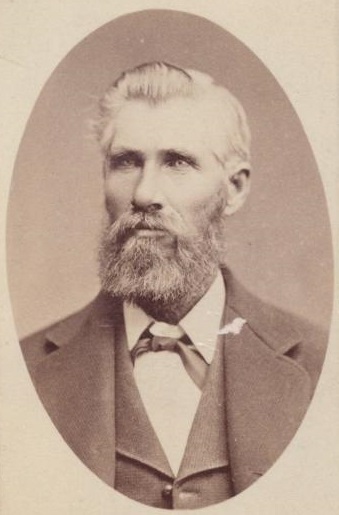
Jonathan Ellis Layne
Birth
Tuesday, Jan 13, 1835
Bowling Green, Indiana
Baptism1
July 1843
Nauvoo, Illinois
Baptized by: J.M. Horner
Death
Sunday, Feb 12, 1899
Cardston, Alberta, Canada


History of Jonathan Ellis Layne
Taken from his journal, with some additions by his daughter, Anna Elizabeth Layne Wilcox.
Jonathan Ellis Layne was born January 13, 1835, near Bowling Green, Clay County, Indiana. He was the 2nd son and 5th child of David Layne and Lucinda Bybee Layne. His father was a preacher in the Campbellite Church, and his mother was also a member of that church.
David Layne and his wife’s cousin, Byrum Bybee, went to hear the preaching of two Mormon missionaries during the winter of 1838 and were so well pleased with what they heard that they decided to become Mormons. But before that opportunity came to David, he died in 1839, when Jonathan was only four years old.
In 1842, Jonathan’s mother took her family of eight children and started for Nauvoo, Illinois, a distance of about 250 miles. She went with her father, Lee Allen Bybee, three of her brothers, and their families. They found a place to live about 5 miles, and a little east, of Nauvoo.
Jonathan was baptized in July 1843, when he was 8 years old.
During the month of June 1844, the report of the coming of mobs kept the people in alarm both day and night. Jonathan was present at a muster of the Nauvoo Legion when the prophet Joseph, as Commander, made his last public address. Jonathan wrote, “On the night of the 27th of June the house seemed to be full of evil spirits, and the next day Grandfather Bybee came and told us that Joseph and Hyrum had been murdered, and such a time of mourning I have never seen before or since.”
When the bodies of Joseph and Hyrum were brought to Nauvoo, the people went by thousands to take a last look at them. Jonathan was not permitted by his mother to go and see them, which he always regretted.
In the fall of 1844, Jonathan, with others, chopped wood, which was hauled to Nauvoo and turned over to the temple hands, and thus “I had the privilege of assisting in the building of the Nauvoo Temple.” In 1845 he went with his uncle, Lee Bybee, to see the inside of the Temple, which was still under construction.
About this time the leaders of the church instructed the Saints to start disposing of their houses and lands and to make wagons and carts, so they would be prepared to leave Nauvoo for the west when the time came. Jonathan says their home consisted of a small brick house and ten acres of land. They were forced to sell it for eleven dollars’ worth of black, bitter flour. The sufferings and indignities the people had to go through could only be realized by those who went through them.
In May 1846, Jonathan’s mother and her family, her father, and three of her brothers and their families left Nauvoo for the west. Later that summer Jonathan became very ill with fever and ague, and his family had little hope for his recovery. Brother Joseph Young, a Seventy, stopped at their camp, and Jonathan asked that Brother Young administer to him. The family said it would do no good, but Jonathan insisted, so Brother Young did administer to him. Immediately Jonathan wanted something to eat, the first for nearly a week. The next day he was able to get up and was soon well again.
They stopped awhile at Mt. Pisgah, where Jonathan’s two sisters and their husbands had gone ahead of the rest, and had built log houses and had raised some corn. The corn was frost-bitten, but they were able to grind it and use it for bread. They found that even frost-bitten corn-meal was a hundred percent better than the bitter black flour they had on the way from Nauvoo.
After living at Mt. Pisgah about 18 months, Jonathan’s mother married a man named Barnett Manzer, and the next spring they moved on to Pottawattamie County, Iowa, where the family prepared to stay for a while until they could move on west. A son, Stephen Manzer, was born to Jonathan’s mother and Mr. Manzer about June 1850.
In the summer of 1851, nearly all of the Church members living in Pottawattamie County prepared to leave the next year for Salt Lake Valley. During this journey many of the Saints became ill and died of cholera and were buried alongside the trail. Jonathan wrote, “Death was stalking abroad in daylight as well as in darkness.”
They crossed the Platte River about 50 miles above Ft. Laramie and camped there three or four days, as the feed for the livestock was very good.
Jonathan was very interested in the new experience he was having now — that of climbing mountains. He loved the mountains, with the great variety of timber, pine and spruce, and the magnificent scenery. From the hills bordering the river, they could see great herds of buffalo. They had to guard their camps very carefully at night to prevent the buffalo from going between the wagons and stampeding the cattle and horses.
One day when they had stopped for noon, quite a large group of Cheyenne Indians in their war paint came up to them. The Indians seemed hostile, and the people didn’t know just what to do. So, to keep the Indians from knowing how frightened they were, they got out their fiddles and played while the young people danced. This amused the Indians, and after being given a few gifts, they moved on, much to the relief of the company.
Jonathan tells of camping on the Sweetwater and other places, and on the Green River. From there they could see the Big Wind River Mountains.
The morning they left Fort Bridger they had their first experience with a mountain snow storm. There was about 5 inches of snow on the ground, and it took them until noon to round up their cattle, which had scattered everywhere. They made camp on the Weber River, about where the town of Henefer is now located. Here Jonathan married a widow in their company, Mrs. Lucinda Bassett. He said, “At the time I could have carried on my back, at one load, all we possessed, but we had plenty of faith in God, the Eternal Father, who has never yet forsaken us.” This marriage took place in 1852.
They moved on until they reached a place where, before them, lay the valley they had come so far to see. They were moved to tears of thankfulness. They reached Salt Lake City on September 27, 1852, and the next day they were ready to go on to Ogden, in Weber County.
Jonathan’s stepfather, Barnett Manzer, his mother, his brother Elihu Preston Layne, stepbrother Stephen Manzer, and sisters Nancy Maria and Jerusha Emeline went south to Nephi, Juab County.
Jonathan, his wife, and his wife’s sister and brother-in-law, John Lasley, went to Sessions Settlement, now called Bountiful. Then they went on to Weber County, where some of the Bybee family had settled.
They worked very hard, cutting their own roads through heavy timber and spending that first winter in a willow hut. Jonathan made a couple of chairs and a table with only an auger, awl, and pocket knife for tools. They built their own bedstead. They had two tin plates, a few broken knives and forks, a tin cup or two, and a small bake kettle. He said they had straw on their bed, and there were plenty of ticks in the sagebrush nearby (wood ticks). But people were kind to them, and Jonathan said, “I feel to ask God to reward a hundred fold all men and women who have been kind to me.”
Jonathan and Lucinda lived in Uinta, Weber County, about six months. While there he was ordained a Priest and was sent out with a companion as ward teacher. He said that from then (1853) until 1888 he spent about thirteen months out of every year acting as teacher among the people. Their first child, Charles Ellis Layne, was born June 12, 1853.
In 1855 they moved to Bountiful, where they hoped it would be easier to get work. In June 1856 Jonathan was ordained a Seventy and walked to his Quorum meetings in Salt Lake City as long as they lived in Bountiful. He worked on the East Bountiful Tabernacle during the summer of 1857 until September, when Johnston’s army approached Utah.
A company of thirty men, Jonathan among them, volunteered to go and meet them. They went to Salt Lake City, where President Brigham Young talked to them and promised them that if they would do right, not a hair of their heads would be hurt, and they would all return safe and sound. They, with a group from Salt Lake and some from Provo, started for Fort Bridger under the command of Horton Haight, without enough arms, clothing, or provisions. They were mounted…
…privations they had gone through there. But in April 1887, he decided to go to Alberta, Canada, to be free from the persecution then going on because of polygamy.
He went to Sunday School as usual, then went home, put what he had to take with him in a wagon, and started out. He left his families, wanting to find a place for them to live before they made the long journey. He was very … to leave Lewiston but felt it was for the best.
At Dillon, Montana, he stopped with his son Will, to wait until some of the other brethren came along. Will operated a saloon in Dillon, and during the nine days Jonathan was there he tried to get him to sell out his business and engage in something better.
On the way to Canada, Jonathan worked on the railroad at Drummond for a week. He reached his destination in Alberta in June 1887, and immediately began clearing land so he could plant crops and a garden. He had been there only a few days when he was appointed to be the first Superintendent of the first L.D.S. Sunday School in Canada. He also brought the first load of logs in to Cardston.
At a meeting held on the 19th of June, he prophesied that the new country would produce for them all that their Cache Valley lands had produced, and that Temples would yet be built there.
Jonathan helped haul logs for a home for his family and for several other homes. He started back to Dillon, Montana, August 24, 1887, to meet his wife and her nine children. His first wife, Lucinda, and her family remained in Lewiston. They arrived back in Cardston September 29, 1887. Three years later, Anna’s 10th child, a boy, was born.
Elizabeth Layne Wilcox, a daughter of Jonathan and Anna, wrote: “I was nine years old when we made the trip from Lewiston to Cardston. To the children of the company it was all fun, but not to the dear mothers. They were leaving their homes to go they knew not where. I can never forget the camping at night, the smell of food cooking over a camp fire, the evening prayer, and the good nights. Then in the morning, all the bustle and hurry, getting the breakfast, rounding up the horses, reloading the wagons.
“Father was a builder as well as a tiller of the soil. He helped build churches and homes in Ogden, Lewiston, and Cardston. He taught his children that to live and progress one must work. He would not tolerate evil speaking against his friends and neighbors, and above all against the authorities of the Church. He loved and lived close to nature. He loved to garden and to give the produce to his neighbors and to those who needed it.
“Father loved the violin, and with others, played for the dancing parties. There was always someone around to offer them a drink, and rather than be tempted, he sold his violin.
“In his day, books were hard to get, but he read everything he could find. He cherished the teachings of the Bible and all the church works. He sought to live in accord with them and prayed always that his family would follow in that belief.
“He was a tall man, six foot two, with deep-set expressive eyes and abundant gray hair and beard. He was of a nature that led people to confide in him and seek his advice. He died February 12, 1899, just seven weeks after the death of his wife Anna. He was loved and respected by all who knew him. A good life, and a good man, gone to his reward — father of seventeen children.”
He and his wife Anna are both buried in Cardston, Alberta, Canada.
Jonathan wrote an autobiography of which a copy of is located at Brigham Young University, Provo, Utah. Jonathan was in Nauvoo, Illinois when Joseph and Hyrum Smith were killed. He came to Utah in 1852. He located in Bountiful, Davis, Utah in 1855. He was involved in the activities of the Utah War. He went to Canada seeking a homestead in 1887. He was among the early settlement of the Canadian colonies.1
Sources
1 Black, Susan Easton, compiler. Membership of The Church of Jesus Christ of Latter-day Saints, 1830–1848. 50 vols. Provo, Utah: Brigham Young University Religious Studies Center, 1989. Private Donor. https://www.ancestry.com/search/collections/5333/records/54092
2 Autobiography by Jonathan Ellis Layne. https://www.familysearch.org/memories/memory/185538067?cid=mem_copy

Copyright © 2009-2026, Dave Lyon. All Rights Reserved