Converts
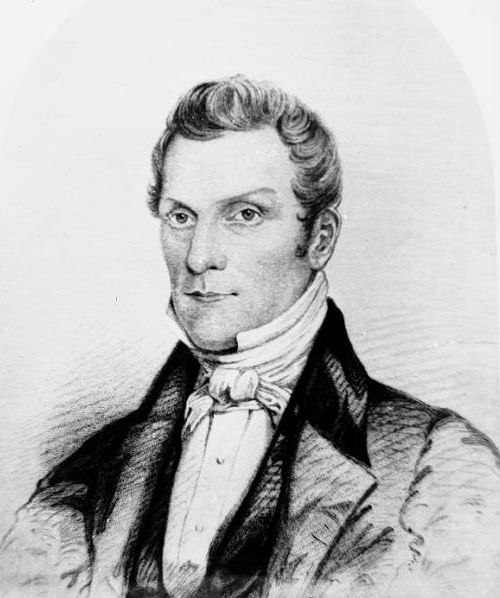
Hyrum Smith
Birth
Sunday, Feb 9, 1800
Tunbridge, Vermont
Baptism
Jun 1829
Death
Thursday, Jun 27, 1844
Carthage, Illinois
Burial: Nauvoo, Illinois


Hyrum was appointed Church Patriarch and assistant to President of the Church, 1841. Hyrum was one of the eight witnesses to the Book of Mormon, 1829. Hyrum was a member of the Nauvoo 4th ward.
Hyrum filled a number of important missions for the Church. He labored for some time as a member of the First Presidency and succeeded his father, Joseph Smith Sen., as Patriarch of the Church. He died as a martyr, being assassinated by a mob in Carthage jail. Hyrum was also one of the eight witnesses to the Book of Mormon. He was called by revelation on a mission to Missouri, preached in Michigan, Indiana, Illinois, and Missouri, as he traveled through these States, together with John Murdock and Lyman Wight. He labored as a missionary in Colesville, Broome county, New York, and other places in the same state. He presided for a short time over the Colesville Branch, migrated to Kirtland, Ohio, in 1831. Hyrum was appointed and set apart to visit some of the branches of the Church in Ohio. He filled a special mission to Thompson, Ohio, and other places, in company with Reynolds Cahoon. He was called by revelation to travel with Cahoon. He filled a short mission in Ohio and Pennsylvania and also made a trip to Missouri. He traveled through southern Michigan, preaching and getting volunteers for Zion’s camp. He accompanied the Prophet Joseph Smith Jr. to Michigan. He made a missionary and business trip to New York, together with Bishop Newel K. Whitney. He accompanied Joseph Smith Jr. on his mission to the Eastern States. He was called on a mission to the States, to exchange lands, sell stock and obtain funds for the building of the Nauvoo Temple. Dr. Isaac Galland was to accompany him. He was accompanied by William Law on a mission to the Eastern States.
Hyrum served as second counselor to President Joseph Smith, from 1837 to 1841. He removed with his father’s family to western New York when about nineteen years old. Like his brother Joseph, Hyrum spent his early years in agricultural labors, and nothing of particular note characterized that period of his life. He speedily became a believer in Joseph’s mission, and by him was baptized. He was one of the eight persons permitted to view the plates from which the Book of Mormon was translated, and his name is prefixed to it as a witness. November 7, 1837, at a conference assembled in Far West, Missouri, he was appointed second counselor to President Joseph Smith, instead of Frederick G. Williams, who was rejected. January 19, 1841, he was called by revelation to take the office of Patriarch to the whole Church, to which he had been appointed by his deceased father, by blessing and also by birthright, and was likewise appointed a Prophet, Seer, and Revelator. He was personally connected with many of the principal events of the Church, up to the time of his death, and in the various offices he filled won the loved and esteem of all persons. In the revelation calling him to be the chief Patriarch, the Lord thus spoke to him: “Blessed is my servant Hyrum Smith, for I the Lord love him, because of the integrity of his heart, and because he loveth that which is right before me, saith the Lord.” (D&C 124: 15). He was tenderly attached to his brother Joseph, whom he never left more than six months at one time, during their lifetime. He was arrested with him at Far West, Missouri, and imprisoned with him at Liberty, and finally spilt his blood with him at Carthage Jail. In this catastrophe he fell first exclaiming, “I am a dead man,” and Joseph responding, “O dear Brother Hyrum!” In the “Times and Seasons” we find the following beautiful eulogy: “He lived so far beyond the ordinary walk of man, that even the tongue of the vilest slanderer could not touch his reputation. He lived godly, and he died godly, and his murderers will yet have to confess, that it would have been better for them to have had a millstone tied to them.
Taken from Hyrum Smith’s Journal–Missionary travels in Ohio, town by town, and return to Kirtland “to rest for a little Season,” December 1831 to January 1832. Brief notes on meetings in Kirtland. Administered to the sick.Preparation for trip to Missouri. (“The Saints of god that are a going to Zion covvenentted to consecrate their properties to the Bisup at Zion after their arrival.”) Death of daughter Mary. (“Mary was calt from time to aternity…O may god grant that we may meet her again at the grate Day of redemption to part no more.”) Various transactions; selling Book of Mormon. Received blessing from father, 1835. Entries sporadic, sketchy. Collecting money for Construction of Kirtland Temple, 1835.Traveled to various towns: Rochester, Oswego, New York. Visited uncle Silas and Asael, baptizing the former. Sacketts Harbor. Canada. Buffalo. Steamboat back to Fairport, Ohio, all in 1835. Then scattered notes, some dated. List of “Goods Packed for the FarWest.” Some financial accounts. Tried by Judge Austin A. King. Confined to jail. (“Many call to see us out of curiosity to view us as they would an elephant.”) Sent petition of habeas corpus. Visitors permitted. Mistreatment by jailer. To Gallatin for appeal in spring, 1839.1
1 Black, Susan Easton, compiler. Membership of The Church of Jesus Christ of Latter-day Saints, 1830–1848. 50 vols. Provo, Utah: Brigham Young University Religious Studies Center, 1989. Private Donor. https://www.ancestry.com/search/collections/5333/records/82719?gsfn=hyrum&gsln=smith&ml_rpos=2 Smith, Hyrum, second counselor to president Joseph Smith, from 1837 to 1841, was the second son of Joseph Smith and Lucy Mack, and was born Feb. 9, 1800, at Tunbridge, Vermont, and removed with his father’s family to western New York when about nineteen years old. He married Jerusha Barden, at Manchester, N.Y., Nov. 2, 1826, by whom he had six children, Lovina, Mary, John, Hyrum, Jerusha and Sarah. He became a widower Oct. 13, 1837, while absent at Far West, Mo., and married Mary Fielding the same year, by whom he had two children, Joseph F. and Martha. Like his brother Joseph, Hyrum spent his early years in agricultural labors, and nothing of particular note characterized that period of his life. He speedily became a believer in Joseph’s mission, and by him was baptized in Seneca lake, in June, 1829. He was one of the eight persons permitted to view the plates from which the Book of Mormon was translated, and his name is prefixed to it as a witness. Nov. 7, 1837, at a conference assembled in Far West, Mo., he was appointed second counselor to Pres. Joseph Smith, instead of Frederick G Williams, who was rejected. Jan. 19, 1841, he was called by revelation to take the office of Patriarch to the whole Church, to which he had been appointed by his deceased father, by blessing and also by birthright, and was likewise appointed a Prophet, Seer and Revelator. He was personally connected with many of the principal events of the Church, up to the time of his death, and in the various offices he filled won the love and esteem of all persons. In the revelation calling him to be the chief Patriarch, the Lord thus spoke of him: “Blessed is my servant Hyrum Smith, for I the Lord love him, because of the integrity of his heart, and because he loveth that which is right before me, saith the Lord.” (Doc. & Cov., 124: 15.) He was tenderly attached to his brother Joseph, whom he never left more than six months at one time, during their lifetime. He was arrested with him at Far West, Mo., and imprisoned with him at Liberty, and finally spill his blood with him at Carthage, Ill., June 27, 1844. In this catastrophe he fell first, exclaiming, “I am a dead man,” and Joseph responding, “0 dear Brother Hyrum!” In the “Times and Seasons” we find the following beautiful eulogy: “He lived so far beyond the ordinary walk of man, that even the tongue of the vilest slanderer could not touch his reputation. He lived godly, and he died godly, and his murderers will yet have to confess, that it would have been better for them to have had a millstone tied to them, and have been [p.53] cast into the depths of the sea, and remain there while eternity goes and eternity comes, than to have robbed that noble man of heaven of his life.” At his death he held various military and civil offices in the Nauvoo Legion and in the municipality. (For further particulars see sketch of Joseph Smith jun. and early Church publications generally.)2
Sources
1 Black, Susan Easton, compiler. Membership of The Church of Jesus Christ of Latter-day Saints, 1830–1848. 50 vols. Provo, Utah: Brigham Young University Religious Studies Center, 1989. Private Donor. https://www.ancestry.com/search/collections/5333/records/82719?gsfn=hyrum&gsln=smith&ml_rpos=2
2 Jenson, Andrew. LDS Biographical Encyclopedia: A Compilation of Biographical Sketches of Prominent Men and Women in the Church of Jesus Christ of Latter-day Saints. Salt Lake City, UT, USA: Andrew Jenson History Co., 1901. http://search.ancestry.com/cgi-bin/sse.dll?db=ldsbio&gss=sfs28_ms_db&new=1&rank=1&msT=1&gsfn=hyrum&gsln=smith&MSAV=1&uidh=m42

Copyright © 2009-2026, Dave Lyon. All Rights Reserved