Converts
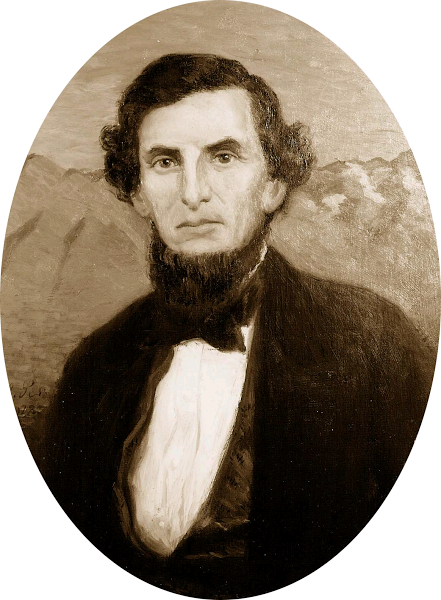
Horace Sunderlin Eldredge
Birth
Tuesday, Feb 6, 1816
Brutus, New York
Baptism
Saturday, Jun 4, 1836
Age: 20
Death
Thursday, Dec 6, 1888
Salt Lake City, Utah
Burial: Salt Lake City, Utah
Age: 72



Horace Sunderlin Eldredge was born February 6, 1816, in Brutus, Cayuga County, New York. He was the son of Alanson and Ester Clark Sunderlin Eldredge. When he was eight years old his mother died, and he was reared by his eldest sister and Aunt Laurana. The influences by which he was surrounded during boyhood were ones of refinement and piety, and we have his own testimony to the effect that at a very early age his mind was engrossed with reflections regarding a future state and the necessity of preparing for it. Religion, too, dominate his thinking. He wanted to be worthy of sometime meeting his beloved mother again. At 16 years of age he joined the Baptist Church, but was not able to accept certain doctrines of the Calvinistic creed. In his journal he tells of his school training where he sand, read, recited, and also played the fife and flute. When his schooling was finished he went to work. In the spring of 1836, at the age of 20 he heard the gospel preached and he became thoroughly interested, and soon afterwards was baptized. He encountered much opposition among his friends, but because it was patterned after the apostolic church, he felt sure it was the true church.
On July 20, 1837, at the age of 24, he married Betsy Ann Chase, who was 18 years of age, in Buffalo, New York. He settled on a farm near Indianapolis, Indiana but prompted by the spirit of gathering he sold his farm in the fall of 1938 and took his baby daughter and wife and went to Far West, Missouri where he purchased a large farm of 230 acres, with a house. He also purchased a lot in town, trusting by prudence, industry, and economy, to secure a comfortable living and a permanent home. However, before lone, disappointment was to be his. He wrote, Difficulties soon arose between our people and the other settler. Jealousies, both political and religious, caused these difficulties. He had occupied his new home only a few weeks when the fires of mobocratic hatred toward the saints broke out in such a fury that they realized they would have to flee. The principles of the settlers were: No law for the Mormon. They were never allowed participation in voting, and finally Governor Boggs ordered the extermination. The Prophet Joseph Smith was jailed and 1,200 saints were banished. Many were murdered, women were ravished, and all were turned out of their homes, so that in December 1838, the Eldredges left Farr West and returned to Indiana where Horace preached Mormonism to his many friends. He always retained title to his real estate in Missouri and never receiver a dollar for it.
During the fall of 1840 he joined the fast growing community of saints at Nauvoo, Illinois, arriving there on October 6th after the birth of a second daughter. He was present when ground was broken for the Nauvoo Temple, and he later assisted in the building until completion in the spring of 1846. While preaching the gospel here, he baptized Hannah Adams, who later became his third wife. He resided in Nauvoo until the exodus there from the spring of 1846, and he shared in the expatriation of the inhabitants of that devoted city and in their march through the wilderness to Winter Quarters. In 1844 he was ordained a seventy in the 13th Quorum, and he left Nauvoo for the west on May 29, 1846. He built a log cabin at Winter Quarters on the bank of the Missouri River, and he wrote in his journal, And on the 26th of November I had my little family under the first and only roof they had been under since early spring. Here he hauled and chopped wood for his part in the work for his company.
At the conference held April 6, 1847, he was present when Brigham Young was sustained as president of the church. He and his family spent two winters at Winter Quarters. Twin daughters were born on June 8, 1847. Conditions were not good for two such delicate children. They lived just three months and were buried at Winter Quarters. During his stay here, he was made marshal of the camp. In the spring of 1848 they started for the Great Salt Lake Valley. They had much trouble with the Omaha and the Pottawattamy Indians who insisted on stealing horses and cattle. They arrived in Salt Lake the following September 22, four months on the way.
From his journal we read: In the spring of 1848, I joined the company of President Brigham Young, who had about 500 teams. Heber C. Kimball joined with us, with another company of about the same number. It was their 2nd pioneer trip for our new home in the mountains, and all were hoping to enjoy a season of rest, at least for a short time, from out persecutions.
It was autumn by the time the company arrived in the valley. They teams were worn out and snow filled the mountains. Many families had to live in the Fort in tents and wagons with much suffering, as they could not get lumber to build their homes. Such was the lot of the Eldredges.
Horace S. Eldredge experienced the familiar incident concerning the crickets and the flight of the seagulls. Drought and lack of experience made the pioneers eager to help each other, and they learned to depend on their God. Hardships were forgotten on July 24, 1849 when the products of the valley were brought together with cheer and happiness abiding. Horace was appointed marshal of the day having done much to plan the celebration for the 24th.
From his journal I quote: Now speaking of myself, the first winter after I arriver in the valley, I was appointed marshal of the territory and assessor and collector of taxes, and it was necessary for us to erect and keep up a military organization for our protection. I was appointed to take charge of the first brigade of infantry and receive therefore the commission of Brigadier General of Militia.
The Eldredges finally now had a comfortable home in the city and a farm in the country. It was the first comfortable home he had lived in since leaving Nauvoo in the spring of 1846. He married his second wife, Sarah Waterous Gibbs on April 21, 1851. Heber C. Kimball performed the ceremony.
At the general conference of the church in October 1852, he was appointed to preside over the St. Louis Missouri conference and act as general church and emigration agent. The duties this placed upon him were of very important and arduous character, but he discharged them well. In 1853 there was an emigration from Europe of 3,000, requiring 300 wagons, 2,000 cattle and provisions for 3 or 4 months of camp life. He spent the winter preparing for the spring emigration. He also purchased machinery and agricultural tools for the saints in the valley. During this time in the east he joined what was called The Mormon Social Club. This organization sponsored plays and musicals for entertainment. He did much to make it successful and was honored one evening and presented an engraved gold ring.
In the autumn of 1854 he returned home to his family. He was now chosen and ordained one of the first presidents of the seventies. Joseph Young officiated in the ordination. During the winter of this year he served as a member of the territorial legislature. Here he helped the enact laws for the growing territory. On February 2, 1855 he took his third wife, Hannah Adams. She was one of those he had baptized in Nauvoo. In the fall 1856 he formed a partnership with William H. Hooper and engaged in the mercantile business, opening with a $15,000 stock of goods in Provo. In the spring of 1857 he was assigned to his formed position and duties in St. Louis, Missouri. He was absent from home for over a year. Mr. Hooper carried on the business. During his absence Johnsons army was ordered into the territory to use up the Mormons and not even leave a grease spot. A prominent citizen of St. Louis advised Horace to leave Utah and bring his family east. Six years later when this same gentleman saw troops being loaded in a steamer to be sent to the battle fields of was, said, I wish to God that my family and effects were in Utah.
In the spring of 1860 Brigham Young asked him to go east for paper mill machinery. This accomplished, he returned and remained home one year then again went to purchase cotton and wool machinery to encourage home manufacturing. Rains, Indians, and railroad trouble delayed his return, but when he did arrive he was shocked to see that considerable business was being done by men having no local interest in building the territory, and these outsiders were making liberal profits. It was, therefore, thought best to adopt a plan by which the profits of at least a portions of the business would be retained here and give the real settlers and consumers some of the profits. Hence Z.C.M.I. was started on October 1868, and in the spring of 1869 with business growing, stock was sold to some four or five hundred people. Horace S. Eldredge increased his stock to over $60,000.
But business pursuits by no means engrossed all his time and attention. In the spring of 1862, after having served an additional term in the legislature, he was appointed church emigration agent at New York, which appointment was repeated one year later. So from 1864 through 1869, he aided the emigrating saints. Now his time was mostly devoted to business affairs. He traveled to California and to the east purchasing merchandise for the Z.C.M.I. He returned home January 27, 1870. He now established the Bank of Deseret later known as the Deseret National Bank.
At the April conference in 1870 he was called to preside over the European mission. He was absent for about fourteen months, during a portion of which time his health was very poor. His wife, Chloe, and 25 missionaries were with him. They worked in England, Scotland, and Wales. They traveled up the Rhine River and worked in Venice and Naples, Italy and Austria and Germany, Copenhagen, Denmark and Sweden, returning home on July 1871. While in Naples he was impressed by the way milk delivered. The vendor drove his goats down the street blowing a shrill whistle as he went. Those wanting to purchase milk took a container to the vendor who milked the goat on the spot. Thus any amount could be purchased and it was fresh to say the least. Horace thought that his plan might work in the Salt Lake Valley.
Horaces lungs were now badly affected by the damp climates he had lived in, but he still made repeated journeys to the east and the Pacific Coast on business. He served several times as superintendent of Z.C.M.I. In 1870 he had a large addition built onto the Salt Lake store and in 1880 established an Ogden store. On January 20, 1881 he retired. It was said that Eldredge, Hooper, and William Jennings turned Main Street in Salt Lake into the quarters of princely merchants. He came through Mormon troubles in Missouri and Illinois. He led emigrant trains across the plains. He is considered the founder of commercial commonwealth of Utah worthy of good will toward all. The disease, which terminated his life, was lung trouble from which he suffered a number of years. He died at his residence in Salt Lake City on September 6, 1888.
Nephi Jenson says of him: Horace Sunderlin Eldredge was a man of magnificent physique. He was fully six feet in height, broad shouldered and compactly built. He had a fine countenance, his forehead being broad and high and features of exquisite mold. His eye was clear and impressive and his whole appearance expressive. His voice was peculiar, having a remarkable resonance. When he made up his mind on any matter, he could scarcely be moved and he generally took an unequivocal stand upon every point of importance with which he had to deal, so that there was never any reason for doubt as to where he stood.
In fact, this trait was apparent even in family affairs. At one time one of his daughters married a man he felt was below her station in life, and he immediately disinherited her. He never relented in this matter, but after his death her mother saw that she received her rightful inheritance. He had a great native force and was strikingly straightforward in his utterance. He had most unqualified contempt for every species of trickery to which he never resorted in his financial affairs.
At the time of his death he was 72 years of age, having made 19 trips across the plains. He had 8 children by his first wife: 7 girls and 1 boy. The boy was a twin dying 13 days after his twin sister. The first two girls lived. The third child died at 1 year, 5 months. The fourth child lived only 10 months. The twins were only 3 months old and the last two girls reached adulthood.
His second wife had 4 children. The oldest boy died at 12 and the youngest boy died at 10. The two girls lived. The oldest being my Grandmother, Eliza Evaletta Eldredge Grant.
This third wife had six children. One girl died at one year of age. The other daughter and four sons lived.
The fourth wife had ten children: 6 sons and 4 daughters. The oldest son died at one year. The rest lived. There were a total of 28 children, 8 of who died and 20 who lived.1
Sources
1 History of Horace Sunderlin Eldredge by Evalettta Grant Thompson, a Great-Granddaughter

Copyright © 2009-2026, Dave Lyon. All Rights Reserved