Converts
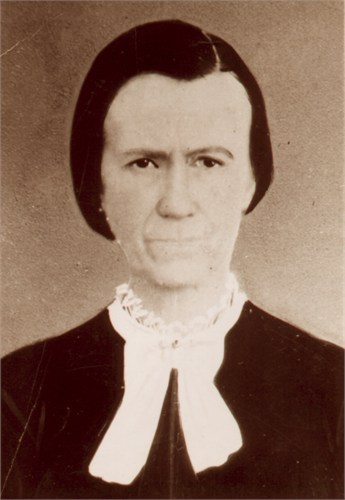
Caroline Farozine Skeen
Birth
Wednesday, Apr 15, 1812
Sumner, Tennessee
Baptism
Monday, Mar 9, 1835
Simpson County, Kentucky
Age: 22
Baptized by: James Emmet and Peter Dustin
Death
Wednesday, Aug 4, 1875
Panguitch, Utah
Age: 63


John and Caroline Butler
At age 23, in 1831, John married Caroline Skeen, daughter of Jesse and Keziah Taylor Skeen. Caroline was born April 12, 1812, on an estate along Drake’s Creek in Sumner County, Tennessee. She was the daughter of what was, in their day in Kentucky, a middle class family, her parents having considerable land—1,450 acres—and eleven slaves in their household of twenty-two. It was said that Caroline never combed her own hair until after her marriage (Hartley); her Negro mammy combed it.
John’s family would have been classed yeoman in the Kentucky society of their day. They had small holdings and were comfortably situated on a small farm of 600 acres. Fortunately for them, considering John’s frail health, they apparently had the help of at least two Negroes, possibly the slaves given to Caroline at their marriage, and who had been freed by John. The Butlers did not believe in slavery.
Both John and Caroline were from families who had come to America before the Revolution and had fought for the cause of freedom against the British. They had pioneered along the early frontiers.
So these two were not unprepared for the rigors they encountered in embracing the Church of Jesus Christ of Latter Day Saints in its infancy, nor for the necessity of defending their beliefs with great sacrifice and courage. They had heard the stories by or about their forebears, and these steeled them in their time of “refining.”
John, with Caroline’s support, continues to search for the word of God but “could find no relief” although he continued to go to meetings. When one of the men of the Baptist church tells him the Lord will continue to chastise him until he agrees to preach their faith, John is filled with a rebellious spirit and decides he will quit going to the meetings, as there is such a spirit of contention and nothing to be gained.
Discouraged, because he also did not seem to be able to learn what he wanted to know through study of the scriptures and his prayers, John goes home and tells his wife, Caroline, that he is going to give it all up.
He reports that “it hurt her feelings very much indeed. I then went to put up my horse. My barn was up by my Orchard. When I had got there I found that a wind storm had passed over when I was away and had destroyed several of my fruit trees by blowing them down and had blown off a great deel of the fruit from the other trees. When I saw what had happened I began to feel very angry to think that the Lord should send such a storm to do me so much damage. And still feeling the same independent spirit I stood up looking towards the heavens saying I would not preach such stuff as my Baptist Brethern told me I would have to preach. And if he thought he would make me to try it and I would quit praying to him for he would not answer me and I would be as independant as he. While in this exercise of mind there was several streeks of lightning passed before me in the heavens. I said ‘I know you can strike me dead with lightning but pop away if you wish for I will neither preach, pray, go to meeting, nor read the scripture any more.’”
He then gets some corn tops and begins feeding his horses when he hears a voice which says, “I will set on you a refiners fire.” He turns to see the speaker, but there is no one.
Realizing what he has done, he returns to the house and relates his experience to Caroline. One can imagine the anxiety of this good woman, who has followed his searchings and, quite possibly, is searching for her own witness—probably with some limitation on her understanding of his condition, as research shows that her own family appears to have no formal religious affiliation. But we can imagine that she herself has developed a feeling of religious conviction, as we have noted earlier in John’s report of her hurt feelings when he decides not to read any more scripture.
After the interview with Caroline, John determines to read Malachi, which he does, reading it through twice. In Malachi it speaks of the refiner’s fire. John then decides “never to open it again” but to go once more to pray for the last time.
He retires to a field where he had made prayers before, but he reports, “Fifty feet from the house my whole mental powers seemed to be drawn out to God to know the truth and the true order of his Kingdom, and if I could only know that I would do anything even to the laying down of my life if necessary.”
He hears the voice again saying, “Stand still and see the salvation of God and that will be truth.” “That instant a light shone round me. I was fill’d with the Spirit of the Lord and saw clearly that God would save all the workmanship of his hands and truth would stand or be set up in our midst, and it will not need propping up as the sects of the day had continued to do. From this time I began to look for something to come forth different to what we then had in any church. I often told my bretheren that the truth would stand alone and might be told by an illiterate man. It could not be put down.”
He tells that, following this spiritual manifestation, things go along “tolerably well.” He continues to attend meetings where he agrees to preach, but mostly on the subject of repentance.
He also was “keeping school at that time, for I was unable to do much hard work being sickly from my boyhood.” They must have depended heavily upon their servants to work the land and do the heavy tasks in a household in those early days.
One can imagine the responsibility and worry Caroline assumed, for which she was probably not prepared, having come from a home where there were many slaves to do her bidding.
Now, along with all of the above, she has children to bear and rear. So far, there are three:
- Kenyon Taylor — 17 November 1831
- William Alexander — 20 April 1833, who died four months later
- Charity Artamesia — 13 June 1834
Heartaches for this young couple, and joys. One imagines their sorrow when leaving the little grave when they move to Missouri to be with the Saints.
March 1, 1835, came the announcement at the Baptist meeting that two Mormon Elders were coming to preach. When John decides to hear them, two Baptist men are appointed to accompany him.
In John’s words, “I expected they would speak from their golden bible but they did not and to my astonishment, they commenced preaching the first principals as set down in the new testament. This astonished me. I knew every word they said to be truth for I had the testimony of it. I asked them a few questions and they kindly answered them. I then told them that my house was a home for them as long as they wished.”
The “brethren” with him say to one another, “how John is taken up with them, see his mouth is wide open to swallow it all, this doctrine will just suit him for it is what he has been seeking after…”
John invites the elders to come and preach at his home, then returns to tell his family what he has found. His mother, who is staying with them, says, “Yes, that is just like you, you were not content with the Methodist, then you joined the Baptist, and they do not suit you, now you will join these Mormons.” But, later, John’s mother, too, recognizes the truth.
John’s reply to his mother’s comment is that the Lord has said try all things and hold fast that which is good.
Caroline, apparently, has received her own witness before her husband, and supports him in his new found faith. When he comes home from a meeting and reports to her that “They preached the Order of the kingdom and I had never heard any thing so plain in all my life before. A child could understand it all. It was just the thing I had been hankering for…I asked my wife what she thought of the Mormon Elders. She said she thought that they were men of God and that it was the only true Church of God and only way to be saved."1
Sources
1 JOHN LOWE AND CAROLINE SKEEN BUTLER — OF COURAGE AND FAITH https://www.familysearch.org/memories/memory/197097383?cid=mem_copy

Copyright © 2009-2026, Dave Lyon. All Rights Reserved